Animal Comparison
Crow vs Raven
Ravens are much bigger than crows, with a wedge-shaped tail, shaggy throat and a deep croak; crows are smaller, fan-tailed and caw. Here's how to tell them apart.
By the WARN Research & Conservation TeamChecked against IUCN Red List & CITES sourcesLast updated
In brief — Crow vs Raven
Ravens are much bigger than crows, with a wedge-shaped tail, shaggy throat feathers and a deep croak; crows are smaller, fan-tailed and caw. Same genus, different species.
The clearest difference is size and tail shape: a raven (Corvus corax) is far larger, up to about 69 cm long with a 116–153 cm wingspan and a distinctive wedge- or diamond-shaped tail in flight, while a crow (such as the American crow, Corvus brachyrhynchos) is roughly pigeon-to-small-hawk sized, 40–53 cm long, with a fan-shaped tail. Listen too: ravens give a deep, throaty croak, crows a sharp, higher caw. They are closely related members of the same genus, but they are separate species, not the same bird at different ages.
See the difference
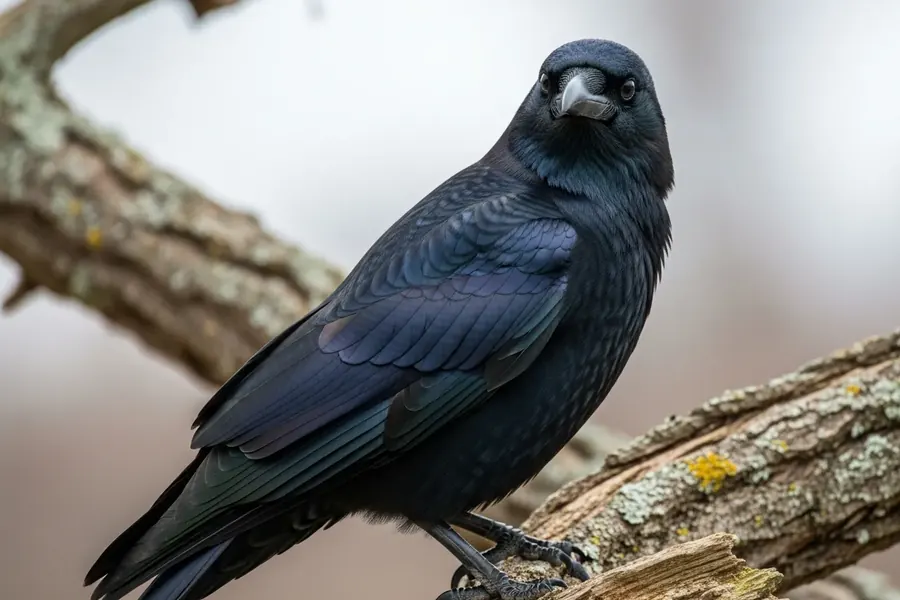
Crow — smaller, fan-shaped tail, higher "caw"
Image: WARN wildlife library
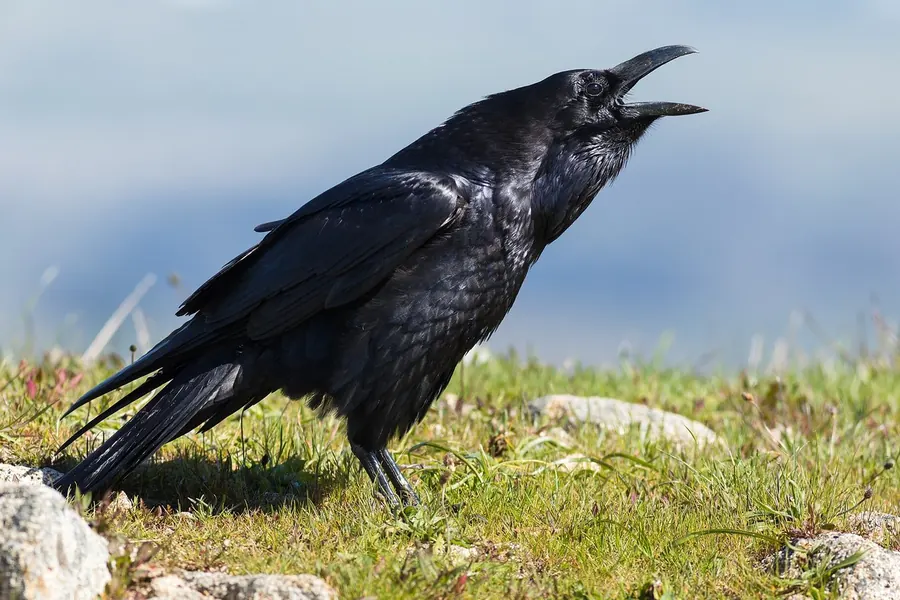
Raven — larger, wedge-shaped tail, deep croak
Source: Wikimedia Commons
Crow vs Raven: At a Glance
| Feature | Crow | Raven |
|---|---|---|
| Example species | American crow (Corvus brachyrhynchos) | Common raven (Corvus corax) |
| Body length | 40–53 cm (16–21 in) | 54–69 cm (21–27 in) |
| Wingspan | 85–100 cm (33–39 in) | 116–153 cm (46–60 in) |
| Weight | ~0.3–0.6 kg (0.7–1.4 lb) | ~0.7–2 kg (1.5–4.4 lb) |
| Tail shape in flight | Fan-shaped, squared-off | Wedge- or diamond-shaped |
| Throat | Smooth | Shaggy, pointed hackles |
| Call | Sharp, higher caw-caw-caw | Deep, throaty croak (gronk) |
| Flight style | Steady, frequent flapping | Soars and glides; does acrobatics |
| Sociability | Highly social, large flocks/roosts | Usually in pairs or small groups |
| Typical lifespan (wild) | ~7–8 years | ~10–15 years (up to 23+) |
| IUCN Red List status | Least Concern | Least Concern |
Which is bigger & stronger?
The raven is clearly bigger: it reaches about 54–69 cm long with a 116–153 cm wingspan and weighs up to roughly 2 kg (4.4 lb), while an American crow is 40–53 cm long, spans 85–100 cm and weighs only about 0.3–0.6 kg (0.7–1.4 lb) — a raven is often described as being nearly the size of a hawk.
Crows and ravens are the two most famous of the corvids — the family of large, glossy-black, strikingly intelligent birds that also includes rooks, jackdaws, jays and magpies. Because both are all-black, both are clever, and both turn up in myth, folklore and poetry, people constantly mix them up or assume "raven" is just a fancy word for a big crow. They are genuinely close relatives in the same genus, Corvus, but they are distinct species with consistent differences in size, shape, voice, flight and behaviour. This guide compares the widespread American crow with the common raven — the two birds most people are trying to separate — and gives you the field marks and behaviours that let you tell them apart at a glance or by ear, whether in a city park or an upland moor.
Size and strength
This is the single most reliable difference. The common raven is one of the largest perching birds in the world, reaching 54–69 cm long with a wingspan of 116–153 cm and a weight up to around 2 kg (4.4 lb) — closer to a hawk or buzzard in bulk. An American crow is 40–53 cm long, spans 85–100 cm and weighs only about 0.3–0.6 kg (0.7–1.4 lb). Ravens also look heavier-headed, with a much thicker, more powerful bill. Seen alone, size can fool you, but side by side a raven dwarfs a crow.
How to tell them apart: tail, throat and bill
When a bird flies overhead, look at the tail. A crow's tail is fan-shaped and opens to a fairly even, squared-off edge; a raven's tail is wedge- or diamond-shaped, with the central feathers longest. Perched, check the throat: ravens have shaggy, pointed throat feathers (hackles) that a crow lacks, giving a rough-necked look. The raven's bill is heavier and more curved, often with visible bristles over the nostrils, while the crow's bill is slimmer and straighter.
Voice and flight
Sound is often the quickest giveaway. Crows make the familiar sharp, higher-pitched caw-caw-caw. Ravens produce a much deeper, hoarse, resonant croak or gronk that carries a long way, along with a wide vocabulary of knocks and bell-like notes. In the air, crows flap steadily and directly, whereas ravens frequently soar on flat wings, ride thermals and perform rolls, tumbles and even brief upside-down flying, especially in courtship or play — acrobatics a crow rarely attempts.
Range, habitat and behaviour
The American crow ranges across North America from the Pacific to the Atlantic and into northern Mexico, thriving in farmland, suburbs and cities, and gathering in enormous communal roosts of thousands. The common raven has a vast Holarctic range across the Northern Hemisphere — North America, Europe, Asia and North Africa — favouring wilder country such as mountains, forests, coasts and deserts, though it is returning to some towns. Crows are the more sociable of the two; ravens are typically seen in pairs or small groups and hold large territories.
Diet and intelligence
Both are omnivorous opportunists that eat carrion, insects, seeds, grain, fruit, small animals, eggs and human food waste, and both rank among the most intelligent birds known, capable of tool use, planning and recognising individual human faces. Ravens tend to take more carrion and are behaviourally dominant over crows at a carcass, while crows are quicker to exploit urban food scraps. Neither is fussy, which is a big reason both adapt so well to landscapes shaped by people.
Conservation status
There is good news here: both birds are listed as Least Concern on the IUCN Red List, with large, stable or increasing populations. Neither the American crow nor the common raven is threatened, and both have expanded alongside human development. That resilience is unusual — many specialist birds are declining — and it reflects the corvids' adaptable diet, high intelligence and tolerance of disturbed habitats.
Did you know?
Ravens are among the few wild birds that fly for fun: they soar to height, tuck their wings and roll or tumble through the air, sometimes flying briefly upside down — play behaviour rarely seen in the more businesslike, flap-and-go crow.
Crow vs Raven: FAQs
Which is bigger, a crow or a raven?
Are crows and ravens the same animal?
How can you tell a crow from a raven?
Can a crow beat a raven?
Do crows and ravens sound different?
Which lives longer, a crow or a raven?
Are crows or ravens endangered?
These animals need us
Understanding wildlife is the first step to protecting it. WARN funds partner-led rescue and conservation where the need is greatest — your support keeps that work going.