Animal Comparison
Crocodile vs Gharial
The gharial has an extremely long, thin snout for fish-only diets; crocodiles have broader V-shaped snouts and eat almost anything. See size, range and status.
By the WARN Research & Conservation TeamChecked against IUCN Red List & CITES sourcesLast updated
In brief — Crocodile vs Gharial
If the snout is thin as a broom handle, it is a gharial; if it is broad and tapered like a wedge, it is a crocodile.
The main difference is snout shape and diet: a gharial has an extremely long, thin, cylindrical snout lined with over 100 needle-like interlocking teeth, adapted purely for snatching fish, while a crocodile has a broader, V-shaped snout with fewer, sturdier teeth built to grip and crush a wide range of prey, from fish to large mammals. Gharials also belong to a separate family (Gavialidae) from true crocodiles (Crocodylidae) and are restricted to a few river systems in northern India and Nepal, whereas crocodiles occur across Africa, Asia, the Americas and Australia.
See the difference
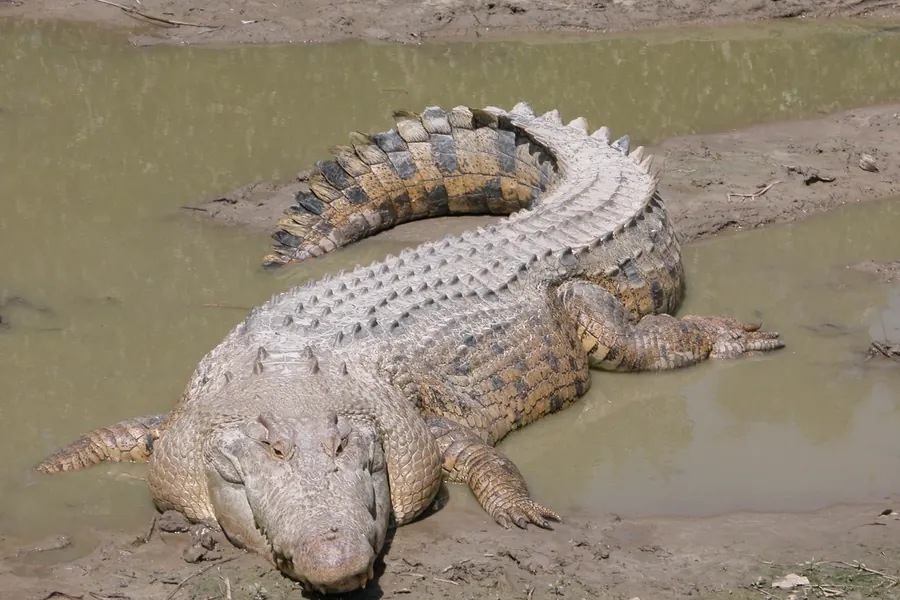
Crocodile — broad V-snout, generalist predator
Source: Wikimedia Commons
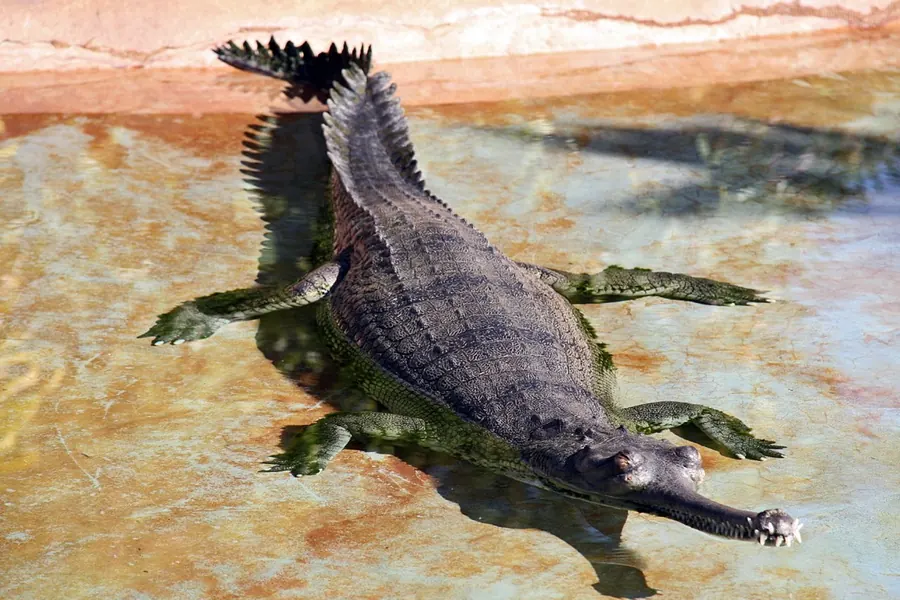
Gharial — ultra-thin snout, 100+ fish-catching teeth
Source: Wikimedia Commons
Crocodile vs Gharial: At a Glance
| Feature | Crocodile | Gharial |
|---|---|---|
| Scientific family | Crocodylidae (~18 species) | Gavialidae (1 living species) |
| Snout shape | Broad, V-shaped, tapering | Very long, thin, cylindrical |
| Adult length | 2-6.3 m (6.5-21 ft), varies by species | Males 3-6 m (10-20 ft); females 2.6-4.5 m (8.5-15 ft) |
| Typical adult weight | Up to 1,000-1,500 kg (2,200-3,300 lb) in saltwater crocodile | Around 159-250 kg (350-550 lb) in males |
| Native range | Africa, Asia, the Americas, northern Australia | Chambal, Girwa and a few other rivers in India and Nepal |
| Diet | Generalist: fish, birds, mammals, carrion | Almost exclusively fish |
| Key visual marker | Fourth lower tooth visible when jaws close | Bulbous 'ghara' growth on adult male's snout tip |
| Lifespan (wild) | 35-70+ years, species-dependent | Estimated 40-60 years |
| IUCN Red List status | Ranges from Least Concern to Critically Endangered by species | Critically Endangered (Critically Depleted, 2025 Green Status) |
Which is bigger & stronger?
They reach similar lengths (both around 5-6 m), but the crocodile is far heavier and stronger, with a large saltwater croc exceeding 1,000 kg against a slender fish-eating gharial's typical 160-250 kg.
Crocodiles and gharials are both members of the reptile order Crocodilia, sharing a semi-aquatic lifestyle, armoured skin and an ancient body plan largely unchanged for tens of millions of years. Beyond that, they diverged into very different specialists. "Crocodile" refers to roughly 18 species in the family Crocodylidae, ranging from the diminutive dwarf crocodile to the enormous saltwater crocodile, found across the tropics and subtropics of Africa, Asia, the Americas and Oceania. The gharial (Gavialis gangeticus) is one of only two living species in the separate family Gavialidae, and survives today in just a handful of river systems on the Indian subcontinent. Its extraordinarily narrow snout, built for catching fish, is the clearest way to tell it apart from any true crocodile at a glance.
Snout shape and teeth
The single fastest way to tell these apart is the snout. A crocodile's jaws are broad and V-shaped, with the upper and lower jaws almost equal in width, so the teeth sit along the jaw margin and the fourth tooth on the lower jaw remains visible even when the mouth is shut. A gharial's snout is dramatically different: extremely long, thin and almost cylindrical, lined with around 110 slender, needle-like teeth that interlock tightly. This shape creates minimal water resistance, letting the gharial snap its head sideways through water fast enough to seize darting fish, something a crocodile's shorter, sturdier snout is not built for.
Diet and hunting style
Crocodiles are opportunistic generalist predators. Depending on species and size, they ambush fish, birds, reptiles, and mammals as large as buffalo or wild boar, using powerful jaw muscles to grip, drag prey underwater and perform a 'death roll'. Gharials lack this bite force; their thin jaws and delicate teeth are adapted almost exclusively for catching fish, which they snatch with quick sideways jerks of the head rather than a crushing bite. This is why gharials are considered harmless to humans, unlike several larger crocodile species, which are responsible for confirmed attacks each year.
Size and the male's ghara
Crocodile species vary enormously in size, from the roughly 1.5-1.9 m dwarf crocodile to the saltwater crocodile, the largest living reptile, with males reaching 6 m (20 ft) and 1,000-1,500 kg (2,200-3,300 lb). Gharials fall in a narrower band, with males typically 3-6 m long and around 159-250 kg, slimmer-bodied than a crocodile of comparable length. Adult male gharials also grow a distinctive hollow, bulbous nasal growth called a 'ghara' (from the Hindi word for pot) at the tip of the snout, used to make a buzzing sound during courtship display; no crocodile species has an equivalent structure.
Range and conservation status
Crocodiles are the most widely distributed crocodilians, occupying rivers, estuaries, mangroves and even open sea across Africa, South and Southeast Asia, northern Australia and the Americas; their conservation status ranges from Least Concern (saltwater and American crocodile) to Critically Endangered (Philippine and Cuban crocodile) depending on species. The gharial's range has collapsed to a tiny fraction of its former extent, now largely confined to the Chambal and Girwa rivers in India, with a small population in Nepal's Chitwan National Park. Fewer than 1,000 mature adults are estimated to remain, and in 2025 the IUCN classed the gharial as Critically Depleted under its first Green Status assessment for the species.
Did you know?
The gharial's bulbous nasal 'ghara' does not appear until males are roughly 11-15 years old, and it works like a natural kazoo: it lets them produce a buzzing hiss audible up to 75 metres away to attract mates, a sound no crocodile can make.
Crocodile vs Gharial: FAQs
Is a gharial a type of crocodile?
Can a gharial hurt a human?
Which is bigger, a crocodile or a gharial?
How do you tell a gharial and a crocodile apart at a glance?
Where do gharials live compared to crocodiles?
Are gharials more endangered than crocodiles?
These animals need us
Understanding wildlife is the first step to protecting it. WARN funds partner-led rescue and conservation where the need is greatest — your support keeps that work going.