Animal Comparison
Bornean orangutan vs Sumatran orangutan
Bornean orangutans have rounder faces, darker fur and huge cheek flanges; Sumatran orangutans are paler, more slender and grow long beards. Both are Critically Endangered.
By the WARN Research & Conservation TeamChecked against IUCN Red List & CITES sourcesLast updated
In brief — Bornean orangutan vs Sumatran orangutan
Same genus, two islands, two faces: Bornean orangutans are stockier and rounder-faced, Sumatran orangutans are leaner, paler and bearded.
The clearest difference is facial shape and colouring: the Bornean orangutan (Pongo pygmaeus) has a broad, round face, darker brownish-red fur and, in mature males, large disc-like cheek pads; the Sumatran orangutan (Pongo abelii) has a longer, narrower face, paler orange fur, and a distinctive long beard and moustache on both sexes. They are separate species, not subspecies, native to different islands, and both are Critically Endangered.
See the difference
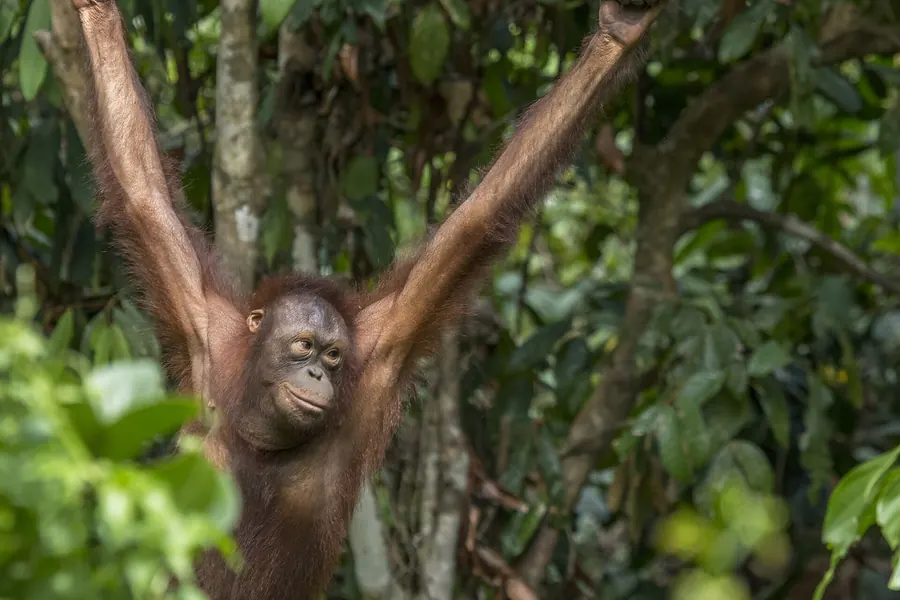
Bornean orangutan — broad round face, darker maroon-brown coat
Photo: Charles J. Sharp / Wikimedia Commons (CC BY-SA 4.0)
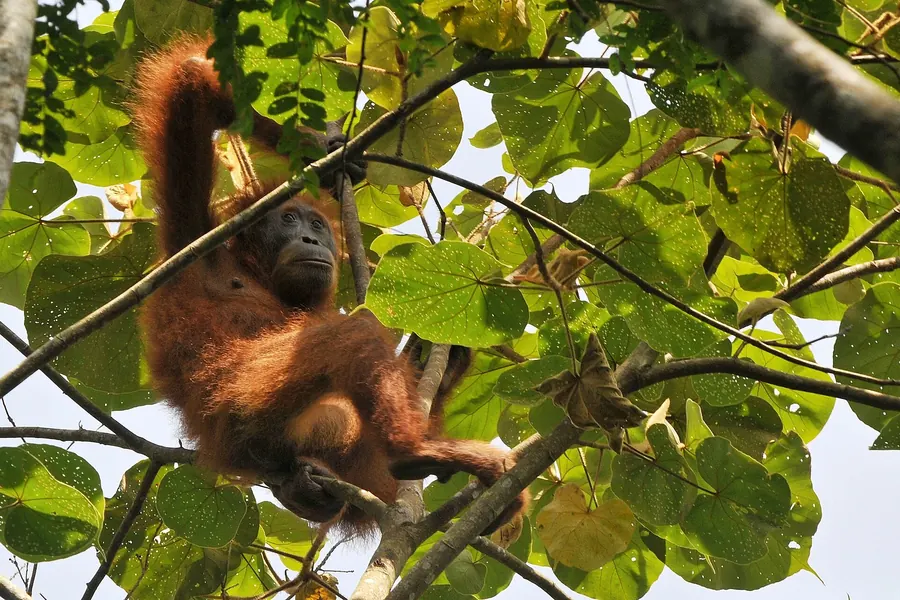
Sumatran orangutan — paler ginger, longer fur, slimmer face
Photo: Jefri Tarigan / Wikimedia Commons (CC BY-SA 4.0)
Bornean orangutan vs Sumatran orangutan: At a Glance
| Feature | Bornean orangutan | Sumatran orangutan |
|---|---|---|
| Scientific name | Pongo pygmaeus | Pongo abelii |
| Native range | Borneo (Indonesia, Malaysia, Brunei) | Northern Sumatra, Indonesia only |
| Adult male weight | ~75 kg (165 lb) | ~90 kg (198 lb), but leaner build |
| Face shape | Broad, round face | Long, narrow face |
| Fur colour/texture | Darker brick-red, coarser | Paler orange, longer and finer |
| Facial hair | Short whiskers, huge round cheek pads | Long beard and moustache, narrower cheek pads |
| Sociability | More solitary, comes to ground more often | More gregarious, almost always arboreal |
| IUCN Red List status | Critically Endangered (~104,700 left) | Critically Endangered (~14,000 left) |
Which is bigger & stronger?
They are very similar in size, with adult males of both around 75-90 kg and about 1.4 m tall, though Bornean males average marginally heavier and bulkier.
Orangutans are Asia's only great apes, and until genetic studies in the 1990s split them, the Bornean and Sumatran populations were classed as one species. They are now recognised as two distinct species (with a third, the Tapanuli orangutan, described in 2017), separated by roughly 1-2 million years of evolution on either side of the Strait of Malacca. Both are large, red-haired, tree-dwelling apes found nowhere else on Earth, but centuries of isolation on different islands, under different ecological pressures, have shaped visible differences in their build, faces and social lives. Because both species are critically threatened by deforestation for palm oil and logging, correctly identifying which orangutan is which matters for conservation reporting, ecotourism and captive-breeding records alike.
Face, fur and build
The single fastest way to tell them apart is the face. Bornean orangutans have broad, rounded faces, and mature dominant males develop huge, flat, disc-like cheek pads (flanges) that can make the face look almost circular from the front. Their fur is a darker, coarser brick-red. Sumatran orangutans have a noticeably longer, narrower face framed by a long beard and moustache present in both sexes, with paler, longer, finer orange-blonde fur and slimmer, less pronounced cheek pads in males. Bornean males also average slightly lighter in body mass than Sumatran males despite looking stockier, because Sumatran orangutans carry a leaner, more elongated frame better suited to near-constant climbing.
Range and habitat
Geography is the cleanest taxonomic split: Bornean orangutans live only on the island of Borneo, shared by Indonesia, Malaysia and Brunei, in lowland and montane rainforest up to about 1,500 m. Sumatran orangutans live only in the northern part of the Indonesian island of Sumatra, in fragmented lowland and hill forests, having vanished from the rest of the island where fossils show they once ranged. The two populations have been separated by the Strait of Malacca for roughly one to two million years, long enough for them to diverge into distinct species rather than subspecies of one animal.
Behaviour and ground use
Bornean orangutans are markedly more solitary and, lacking large ground predators like the Sumatran tiger, descend to the forest floor far more often to travel and forage. Sumatran orangutans are more gregarious and tolerant of associating with other individuals, particularly around fruiting fig trees, and stay almost entirely in the canopy, likely because tigers still hunt on the Sumatran forest floor. Sumatran females also space births further apart, roughly 8-9 years between offspring compared with 6-8 years for Bornean females, giving Sumatran orangutans one of the slowest reproductive rates of any mammal.
Conservation status
Both species are classified Critically Endangered on the IUCN Red List, but their situations differ in scale. The Bornean orangutan population is estimated at around 104,700 individuals, down from roughly 230,000 a decade earlier, an estimated 86 percent decline since 1973 driven by logging and conversion of forest to oil palm plantations. The Sumatran orangutan population is far smaller, estimated at around 14,000 individuals confined to fragmented northern Sumatran forest, having lost about 80 percent of its numbers in 75 years. Both face the same core threats: deforestation, forest fragmentation and illegal hunting.
Did you know?
Sumatran orangutans are among the only great apes known to regularly use tools in the wild, such as stripping leaves off sticks to extract seeds from spiny Neesia fruit, a behaviour far less commonly recorded in Bornean orangutans.
Bornean orangutan vs Sumatran orangutan: FAQs
Is a Bornean orangutan bigger than a Sumatran orangutan?
How can you tell a Bornean and Sumatran orangutan apart by their face?
Are Bornean and Sumatran orangutans the same species?
Which orangutan species is more endangered?
Why are Sumatran orangutans more social than Bornean orangutans?
Do Sumatran orangutans have beards?
These animals need us
Understanding wildlife is the first step to protecting it. WARN funds partner-led rescue and conservation where the need is greatest — your support keeps that work going.