Animal Comparison
Alligator vs Crocodile
The fastest way to tell them apart: alligators have broad, U-shaped snouts that hide their lower teeth; crocodiles have narrow, V-shaped snouts with a visible tooth.
By the WARN Research & Conservation TeamChecked against IUCN Red List & CITES sourcesLast updated
In brief — Alligator vs Crocodile
If the snout is a wide U and the teeth disappear when the mouth shuts, it is an alligator; if the snout tapers to a V with a tooth poking up outside the jawline, it is a crocodile.
The clearest difference is snout shape and teeth: an alligator has a broad, U-shaped snout that hides its lower teeth when its mouth is closed, while a crocodile has a narrower, V-shaped snout that leaves the fourth tooth on the lower jaw jutting up outside the closed upper jaw, visible year-round. Alligators (family Alligatoridae) also live only in freshwater and lack functional salt glands, whereas crocodiles (family Crocodylidae) have lingual salt glands that let many species tolerate brackish and salt water.
See the difference
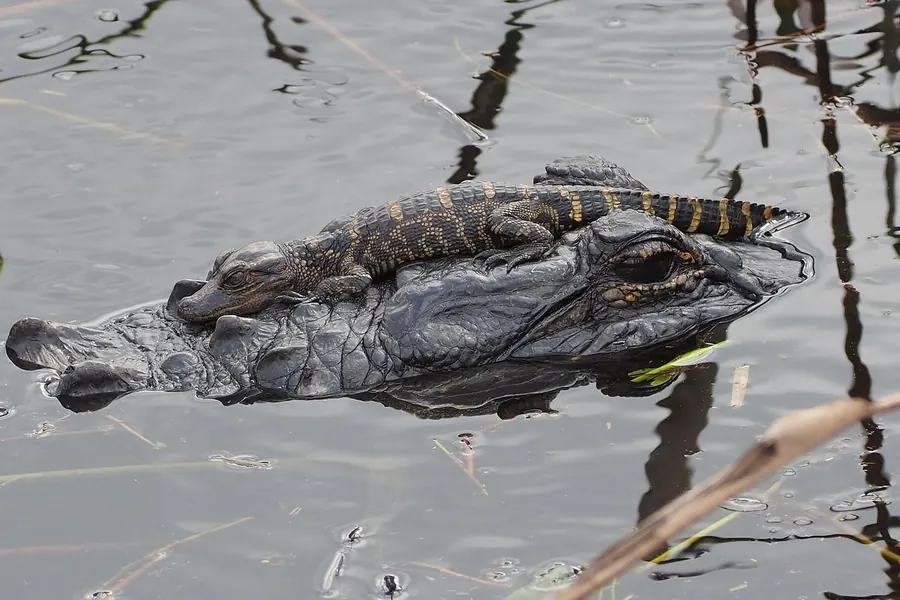
Alligator — broad U-shaped snout hides the lower teeth
Source: Wikimedia Commons
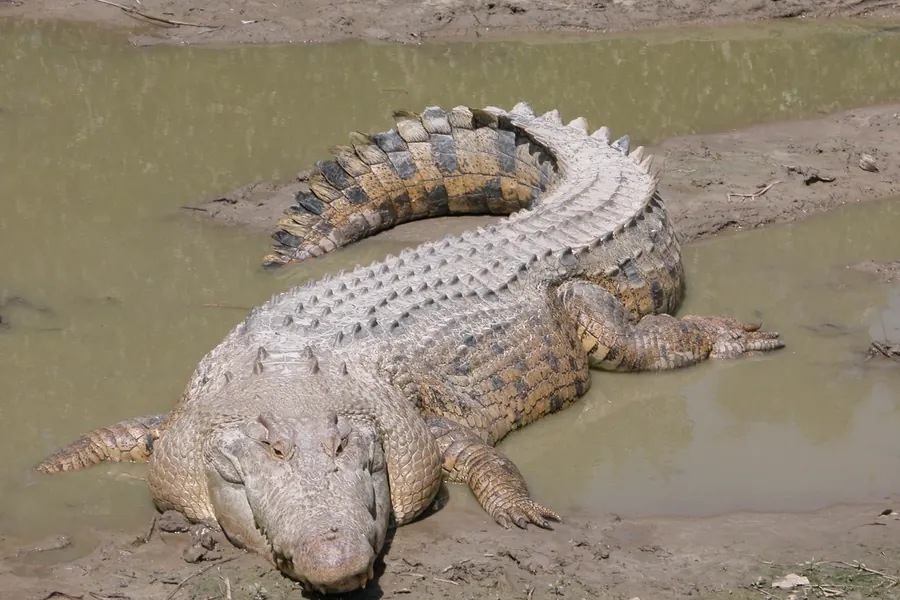
Crocodile — narrow V-snout, 4th tooth stays visible
Source: Wikimedia Commons
Alligator vs Crocodile: At a Glance
| Feature | Alligator | Crocodile |
|---|---|---|
| Scientific family | Alligatoridae (genera Alligator, Caiman) | Crocodylidae (3 genera, ~17-18 species) |
| Snout shape | Broad, rounded, U-shaped | Narrow, tapered, V-shaped |
| Visible teeth (mouth closed) | Lower teeth mostly hidden | Lower 4th tooth visible, upper notch |
| Typical adult size (largest species) | 3.4-4.8 m males (11.2-15.7 ft) | Up to 6-6.3 m males (20-21 ft) |
| Salt glands | Vestigial, non-functional | Functional lingual salt glands |
| Habitat | Freshwater swamps, rivers, lakes | Brackish, saltwater and freshwater |
| Lifespan (wild) | About 50 years | 70+ years, some over 100 |
| IUCN status (species shown) | Least Concern | Least Concern |
| Temperament toward humans | More reclusive, avoids people | Highly territorial, more attacks recorded |
Which is bigger & stronger?
The crocodile is bigger and stronger: the saltwater crocodile reaches 5-6 m and over 1,000 kg, whereas the American alligator tops out around 4-4.5 m and 300-450 kg.
Alligators and crocodiles are both large, armoured, semi-aquatic reptiles from the order Crocodilia, and their overlapping appearance and habitats cause constant confusion. But they belong to separate families that diverged tens of millions of years ago: alligators (Alligatoridae) and crocodiles (Crocodylidae). The distinction is not just cosmetic — snout shape, tooth arrangement, salt-gland physiology and typical size all trace back to different evolutionary pressures and diets. This guide compares the two using two representative species people search for most, the American alligator (Alligator mississippiensis) and the saltwater crocodile (Crocodylus porosus), the largest living reptile, while noting which traits apply to the wider families.
Snout shape and tooth display
The single fastest field ID is the snout and teeth. Alligators have a broad, rounded, U-shaped snout: the upper jaw is wider than the lower, so the lower teeth slot into sockets inside the upper jaw and largely disappear when the mouth closes. Crocodiles have a narrower, tapered V-shaped snout where the upper and lower jaws are roughly the same width, so the enlarged fourth tooth on the lower jaw fits into a notch on the outside of the upper jaw and stays visible year-round, giving crocodiles their characteristic "toothy grin". The alligator's broader snout also delivers extra crushing strength for hard-shelled prey such as turtles, while the crocodile's tapered shape suits fast lateral snapping at fish.
Family, physiology and habitat tolerance
Alligators belong to Alligatoridae, a family that also includes caimans, while crocodiles belong to Crocodylidae, the family of roughly 17-18 "true crocodile" species split across three genera. The functional difference that matters most ecologically is the salt gland: crocodiles have working lingual salt glands on the tongue that excrete excess salt, letting species like the saltwater crocodile move between rivers, estuaries and open sea. Alligators retain only vestigial, non-functional versions of these glands, restricting them to freshwater and only brief exposure to brackish water. This single trait explains why alligators stay confined to swamps and rivers while crocodiles colonise coastlines and islands.
Size, lifespan and range
Size varies a great deal within each family, but the two most-searched representatives show a stark contrast. The American alligator reaches 3.4-4.8 m (11.2-15.7 ft) in males, weighing up to about 450 kg (1,000 lb), and is confined to the south-eastern United States and parts of Mexico. The saltwater crocodile is the largest living reptile: males can reach 6-6.3 m (20-21 ft) and 1,000-1,500 kg (2,200-3,300 lb), ranging from India's east coast through South-East Asia to northern Australia. Saltwater crocodiles also live markedly longer, with wild lifespans estimated at 70 years and some individuals possibly exceeding 100, versus roughly 50 years for American alligators.
Behaviour and bite force
Behaviourally, American alligators are generally more reclusive and tend to avoid people, with fatal attacks on humans rare. Saltwater crocodiles are markedly more territorial and assertive, defend large territories year-round, and are responsible for the majority of recorded fatal and non-fatal crocodilian attacks on humans worldwide. The saltwater crocodile also holds the record for the strongest bite force measured in any living animal, estimated at around 3,700 psi (pounds per square inch), more than double that of a great white shark. These behavioural and physical differences reflect the saltwater crocodile's role as an apex ambush predator across a wide range of prey, from fish to large mammals.
Alligator vs Crocodile: FAQs
Is an alligator a type of crocodile?
Which is bigger, an alligator or a crocodile?
Can you tell an alligator from a crocodile by colour?
Why do crocodiles live in salt water but alligators do not?
Which is more dangerous to humans, an alligator or a crocodile?
Do alligators and crocodiles live in the same places?
These animals need us
Understanding wildlife is the first step to protecting it. WARN funds partner-led rescue and conservation where the need is greatest — your support keeps that work going.